
There’s a reason why so many businesses have a blog section on their website. Writing a blog can transform the online performance of your business.
You can leverage blogging to improve your organic search performance – helping to get your business seen by your target audience. Blogging can also help you to better connect with your audience. Building strong relationships with your audience increases the likelihood of them taking action.
But, how often should you blog for your business? And how can you make sure that your blog writing efforts are producing lucrative results for your business?
Lucky for you, we’ll be diving into the numbers behind how often businesses should blog and the anatomy of a good blog in this article…

How often does your business blog right now?
We’ve seen a lot of business blogs during our time. Many business blogs will have the odd business update once every few months as a cursory way of letting people know about your latest company news.
Other companies will be on the ball sharing weekly or bi-weekly articles about topics that are loosely related to their business. Topics that on the surface seem relevant but as you dive deeper into them you realise there’s no clear direction or goal.
On the flipside, you’ll have the business blog pro’s – the ones who are frequently publishing highly- relevant, targeted, and engaging blog articles. Articles that engage their audience and get them taking action at the end. These are the people who know exactly what they’re doing when they sit down to write a new article for their business blog. They’ve dotted the i’s and crossed the t’s when it comes to writing purposeful content.
So, where does your business sit on the scale of blogging ghost (posting heedless blogs once every blue moon) to blogging pro (frequently posting strategic and purposeful content)?
Take a moment to look at your current blog output and performance. Then carry on reading to find out how you improve upon what you are currently doing to captivate your readers, increase traffic, and improve your conversions.
How often should you blog for your business?
We know blogs are important for the online performance of businesses.
Yet, when it comes to data, there’s very little information on how frequently you should be posting.
The truth is – there is no definitive number out there for how often you should write blogs for your business. The truth is, it depends. It depends on your industry, the size of your company, the reason why you’re posting content, your content quality, the size of your marketing team… and many other reasons.
We know you didn’t come here to hear “it depends”. So, we’ve done the research for you – we’ve scoured the big wide web and pulled together the numbers of how often you should blog.
Publish more blogs to acquire more traffic
General consensus says that you should be blogging 2 – 4 times per week to harness the highest possible results for traffic and conversions. The idea here is that the more frequently you publish blog posts, the more traffic you will acquire.
However, this also depends on the quality of the posts you are publishing. If you are publishing content without giving any thought to the content topics or objectives, you likely won’t see any results.
Hubspot found that companies that had published over 401 blog posts received 2x more traffic than companies with 301 – 400 blog posts.
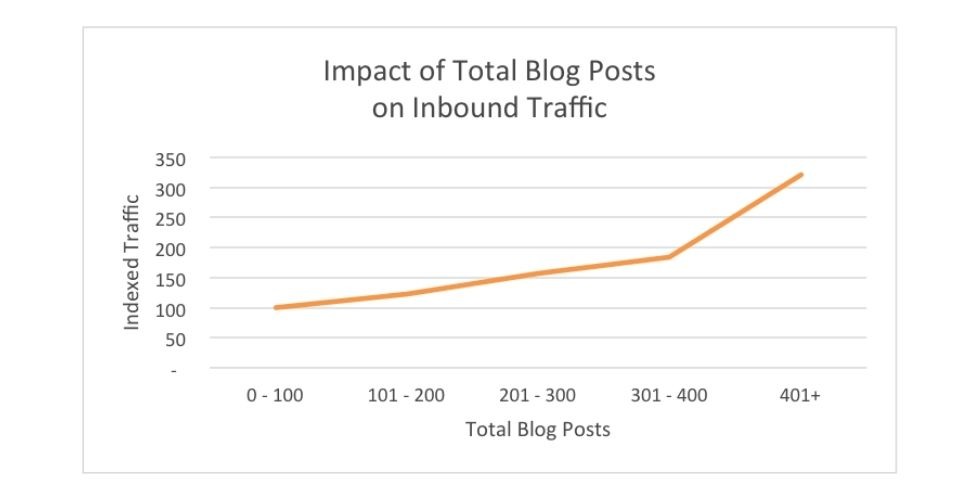
Publish blog posts that are led by a thoughtful content marketing strategy and you will see a positive ROI in terms of traffic and conversions.
In short: the more blogs you publish, the more traffic you will be likely to acquire for your website.
However, the trick isn’t to just churn out blog post after blog post. It’s to produce content that is valuable for your audience. This means conducting thorough content marketing research and formulating a strategic plan of action for what content you’re going to produce, why, and when. This way, any content that you do publish will be highly relevant for your target audience… and will have a better chance of turning that audience into loyal customers!
If you do want a number to aim towards, then aim to hit that sweet spot of publishing 2 – 4 quality blog posts per week.
The proof is in the data
Hubspot analysed blogging data from over 13,500 companies to try to gauge blogging frequency benchmarks. From their analysis, they were able to determine how blogging frequency can impact website traffic and conversions.
They found that companies that publish 16 or more blog posts per month got 3.5 times more traffic than those who posted four or fewer articles per month.
Small teams may struggle to dedicate the time to frequently writing high-quality blog posts for their audience. In this instance, these teams should focus on strategically planning their blog content or outsourcing blog copywriting to help increase the production of quality, relevant blog articles.
Blogging is just as important for B2B businesses as it is for those in the B2C vertical. 72% of B2B businesses have a blog, according to the Backlinko B2B Content Marketing Report. This content marketing report also revealed that long-form content performed best in the B2B space and that B2B decision-makers typically consume 13 pieces of content during the buying space.
Writing a blog is not only good for positioning your brand as a thought leader, it’s also a crucial component of your customer buying journey.
The more articles you have on your website, the more information you will be able to provide potential buyers to assist them with their purchase decisions.
What does a good blog look like?
There’s more to blog-writing than just publishing blog articles. You need to consider all of the ingredients that go into that blog post. The anatomy of your blog post can be crucial to how well it performs online.
Having written hundreds, if not thousands, of blog articles in our time, we’re pretty apt at knowing what it takes to write a great blog post. We’ve written posts that bring in thousands of site traffic per month, posts that convert readers into leaders, and posts that have secured rich snippets in Google Search Results.
But, we don’t want you to just take our word for it. So, we’ll be sharing the data that shows exactly what a good blog post should look like.

In their State of Content Marketing Report, SEMrush analysed the visits, backlinks and social shares of over 1,200,000 blog articles to determine which blog post elements such as the texts’ length, headlines, structure, and the presence of visuals had the biggest impact on content performance.
Here’s what they found…
Longer blog posts are better
Long-form blog posts perform better than their shorter counterparts. It’s common knowledge that any blog post written for SEO purposes should be at least 400 words long.
Long blog posts rank more easily on Google than short blog posts. Outside of the SEO benefits, long blog posts also offer your readers greater information and value than short blog articles.
The State of Content Marketing Report found that long articles of approximately 3,000 – 7,000 word length received twice as many pageviews and 24% more shares than articles of an average length of between 900 – 1,200 words. This suggests that if you want to write content that’s shareable and keeps readers on your site for longer, you need to go long.
Writing long blog articles doesn’t mean just waffling on to get that word count up. It means writing content that is valuable. Your long blog posts should be in-depth and informative. You need to make sure that every word counts which means having to strike that perfect balance between writing an article that’s concise while still being valuable.
Having a complex blog structure wins
When writing blog posts, you need to think about the formatting of your content.
Your blog post should never be a solid wall of text. It needs to have layers to it. As such, having a more complex blog structure wins.
Some key elements to consider when writing your next blog include:
- Subheadings
- Lists (like this one!)
- Headline length
We’ll look at each of these elements in more detail below…
Use subheadings
Your blog post should contain subheadings, such as H2, H3 and H4s to break up your text and add additional context to your blog post. Over half of posts that have a complex structure (i.e. contain H2/3/4 subheadings) are high-performing in terms of traffic and engagement.
On the flipside, 39% of articles that have no structure at all (i.e. do not contain any subheadings) are low-performing in terms of traffic and engagement.
These statistics showcase the value of writing complex blog posts that contain multiple subsections (and subheadings). Going into more detail and breaking up long walls of text with subheadings can result in acquiring more traffic and engagement for your blog posts.
Subheadings also make it easier for people to read your blog posts. They can easily skim-read your blog, picking out the key points and scanning for the information they are most interested in.
So, if you want to write blog articles that people actually want to read, make sure you’re using subheadings.
Include lists
Just like subheadings, using lists can also help make your blog posts easier on the eye.
Using lists such as bullet points or numbered lists make it easier for your readers to continue their reading journey down the page, quickly and easily digesting information as they read your article.
Blog posts that contain at least one list every 500 words of plain text tend to receive 70% more traffic than blog posts that don’t contain any lists at all.
Lists can improve the aesthetics of your blog post by adding white space to your article – helping to break up that daunting wall of plain text.
Ways you can use lists in your blog post include:
- At the end of your blog post introduction to explain what your post will cover
- In the middle of your blog post to break up large sections of text
- When giving examples or suggestions
- At the end of your blog post to summarise what was discussed or share suggested next steps
Take a moment to go through some of your previous blog posts and see if there are any that could benefit from the addition of a list.
Write longer headlines
How much thought do you put into the headlines of your blog posts? Much like the cover of a book, your headline is your opportunity to peak readers interest and encourage them to click to read your blog post.
Writing headlines that are 10 – 13 words long could drive twice as much traffic, and receive 1.5 times as many shares, than shorter headlines that are less than 7 words long.
You only have a few seconds to catch the attention of your target audience. That means you only have a small window of opportunity to capture their attention with your headline.
Longer headlines allow you to add more information to the title of your blog. They also allow you to add emotion and intrigue to your title by using adjectives or persuasive words.
Let’s do a quick test.
Which of the following blog post titles are you most likely to click to read:
- Content marketing strategy guide
- 7 steps to create the ultimate content marketing strategy for your brand
We’re going to go ahead and guess that most of you said the second title “7 steps to create the ultimate content marketing strategy for your brand”. This title uses numbers which helps readers understand what to expect. It always describes the word as “ultimate” which adds emotion to the title and finally the headline ends with “for your brand” which makes it personal to the reader.
So, there you have it! The longer and more descriptive your headline is, the more enticing it will appear to potential readers.
Visual content is best
Finally, blog posts need to be about more than just written words. They need to also include visual content.
Adding an image to your blog post could double your blog post traffic. The content marketing report from SEMrush found that posts containing one image received twice as much traffic as posts that only contain text. Blog posts with images also get 30% more shares and 25% more backlinks.
When writing a blog post, make sure it at least contains one featured image to accompany the text.
Including more images throughout your blog has the potential to further increase your traffic with posts containing 7 or more images being more likely to gain four times more traffic than articles with just text.
While we wouldn’t recommend peppering your blog post with lots of images, we do recommend using them strategically throughout your blog to accompany text, provide additional context or add visual cues.
If you thought images were enough, think again. Blog posts without video receive 92% less traffic and 24% less shares than blog posts that contain at least one video. Therefore, you might want to think about introducing explainer videos into some of your upcoming blog posts. These could be, for example, walk-through videos showing how something is done or they could be informative and educational videos that are then transcribed into a blog post.
These videos could also be repurposed for other platforms such as YouTube or Instagram videos.
Final thoughts on how often you should blog
While it is important to be frequently publishing blog posts for your business, it is more important to produce blog posts that are high-quality.
Try to get into the rhythm of publishing regular blog posts. This can be achieved by developing a content marketing strategy and producing a schedule of upcoming blog topics that you want to publish. By doing this, you will be able to hold yourself accountable to publishing frequent blog posts.
Alternatively, if blog-writing isn’t your thing or you don’t have time to write blogs for your business, you can outsource your blog writing to a content marketing team. At Fika Digital, we help businesses create purposeful blog content that engages their ideal audience and performs well organically.
Along with frequently publishing blog posts, you need to consider how your blog looks. Take time to work on your blog structure and find ways to make that blog post more appealing to readers.
If you need help with auditing your existing blog posts or creating a plan of action for future blogs, get in touch to see how we can support you.
Author
