
There’s a reason why there are over 500 million active blogs around the world. It’s because it works. If you want to get more eyes on your business, a blog is one way you can achieve just that.
The benefits of blogging don’t just stop at expanding your reach. Blogging can also increase audience engagement, help you gain more leads, and improve your bottom line. Businesses that prioritise blogging receive 13X more ROI than those that do not.
Sounds appealing, right?
Then it’s time to dust off your business blog and give it some much-needed love. In this article, we’re sharing some simple tips to help you polish up the performance of your business blog.

Sit down, relax and let’s learn how you can instantly improve your business blog…
Instantly improve your business blog
Writing a blog is easy. Writing a blog that generates powerful results for your business takes careful consideration. It’s an art. It requires research, experience, and skills.
The best way to improve your business blog is to outsource your content marketing and copywriting to an experienced content marketing team who will know exactly how to develop a winning content strategy for your business.
The second best way to improve your business blog is to follow these simple tips to start improving your blog today:
Choose your content topics
Before you even begin writing a business blog, you need to define your content topics. These topics will inform what gets published on your blog.
The content topics you choose need to be relevant to your business, audience and goals.
When choosing content topics for your blog, first ask yourself:
- Who am I writing this for?
- What do I want to achieve with this blog?
- How does this blog relate to my business?
The answers to these questions will help you identify your content topics. You may have several topics that you want to write about on your business blog. However, the more focused these topics are, the more successful your blog posts will be.
It’s important to note that not every content topic that interests your audience will be relevant to your business, and not every content topic that is relevant to your business will be interesting to your audience. It really is important to strike that balance and find the content topics that appeal to your business goals, your audience and your company.
Content pillars and cluster content
Once you have chosen your content topics. You may then be able to distil these down into subtopics. These main content topics will be your ‘content pillars’ and the smaller subtopics will form your supporting content, also known as cluster content.
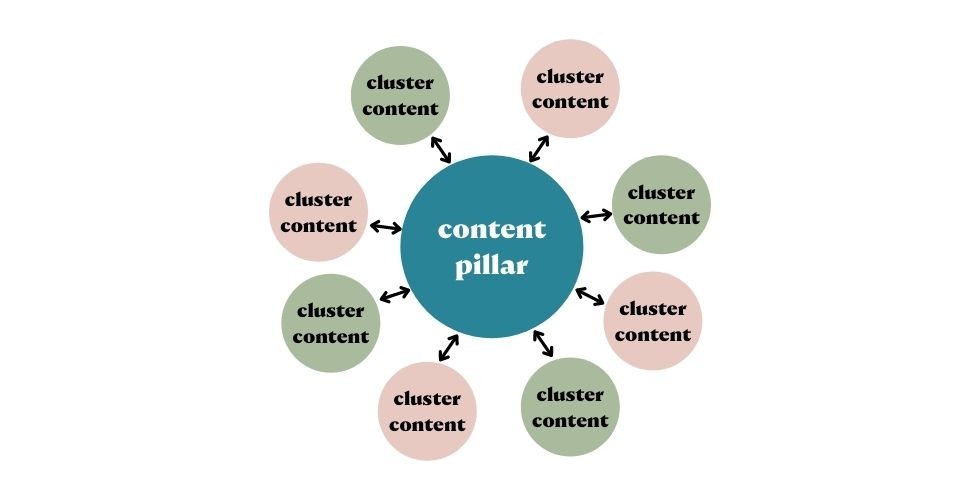
Your content pillars should be aligned with high-value, short-tail keywords. This means that they are broad keywords that are highly relevant to your business (high-value keyword) and that receive a high number of monthly searches in search engines results (short-tail keyword).
Your chosen topics for your cluster content will help add context to your content pillars. For example, if SEO is your content pillar then your supporting cluster content may be SEO tips for beginners, how to do SEO, SEO tools.
After you have completed this exercise, you will likely have a number of content pillars and cluster topics for your business. These topics will help inform your upcoming business blog posts.
Establish your tone of voice
Your tone of voice helps your audience understand what kind of business you are. Are you a serious and professional business? Or are you innovative and fun?
Whatever your tone of voice is, it needs to be consistent across all elements of your business — from your website to your sales documents, printed brochures, emails, social media messaging, and so on.
Your tone of voice isn’t about what you say, it’s about the way that you say it. So, you need to choose your words carefully when writing your business blog to make sure it perfectly captures your brand personality.
If you don’t already have a tone of voice document, the best way to establish your tone of voice is to speak to your audience, listen to your employees, and think about what your business stands for.
From here, you’ll be able to establish a tone of voice that perfectly represents your brand. Then, every time you write your business blog, make sure you are channelling your brand tone of voice.
This will help you to build trust with your readers by having a familiar, consistent voice. It can also be beneficial for helping readers to identify your brand without even seeing your logo or business name – they should be able to read your blogs and instantly know that it’s you.
Finally, your tone of voice can be a powerful tool for encouraging readers to take action. As we said earlier, tone of voice is all about the way you say things. And the way you say something can evoke certain emotions in your readers and listeners.
Prioritise keywords and search intent
Everything you write needs to be written with intent. Specifically, everything you write should be written with search intent.
Search intent, also known as user intent, refers to the primary goal a person has when searching for something using Google (or other search engines). Whenever someone searches for something online, they are usually looking for a particular answer – be it a recipe, an FAQ, a product, a video, or something else entirely.
By prioritising keywords, you can also take steps towards prioritising search intent.
Firstly, you need to do keyword research for your website. Keyword research will help you identify key content topics (that relate to your content pillars and cluster content!) for upcoming blog articles.
You can then reverse engineer these keywords in Google to see what types of content appear in the search engine result pages (SERPs). This will help you to determine whether these keywords are relevant to your business and what type of content you should produce in order to secure the top spot for this keyword. Doing this will also help you to prioritise search intent when doing keyword research for your blogs.
Side note: make sure the content you produce is unique and doesn’t plagiarise another website.
When doing keyword research, keep your content pillars and cluster content in mind. If the keyword has a high search volume (e.g. a search volume of 3,900) this may be best used as a content pillar with supplementary cluster content created for related long-tail keywords.
As a general rule, your blog posts will most often be written for long-tail keywords. Short-tail keywords, on the other hand, will most likely be used for landing pages or for content pillar pages.
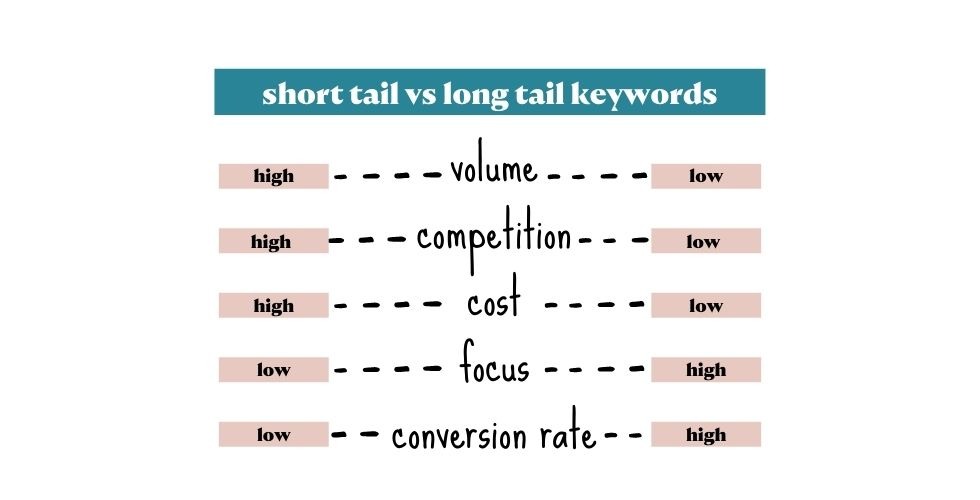
Your keywords should appear naturally in your blog post. Overstuff your blog post with keywords and it will look unnatural to both readers and Google. Instead, choose one main focus keyword for your blog post and aim to use this naturally throughout your blog.
You should also use semantically related keywords within your blog, along with some longer-tail supporting keywords to help further build the relevance of your blog for your chosen keyword.
Remember to use your keyword in the following areas of your blog post (where it fits naturally):
- Page title (usually the H1)
- Subheadings
- Main body of text
- Media alt-text, filename and meta-data
- Blog post meta-data
Optimise images and videos
Sure, content is king. But visual content is where it’s really at.
When you think of a blog post, you likely will think of a long piece of written content. However, the best types of blog posts are the ones that incorporate visual elements such as images and videos.
Images and videos help break up the text, add relevance and keep readers engaged.
Articles with images can gain up to 94% more views than articles without any visuals. So using images and videos in your blog posts is a bit of a no-brainer.
In order to get the most out of your blog post images and videos, you need to optimise your visuals for SEO and on-site performance.
Large media files can play havoc with your website loading time – an important factor for on-site SEO. Before uploading any media files to your website, make sure they are low file sizes. Large image files can slow your website down.
To optimise your images for your blog, you should focus on:
- Image file format (JPEG, PNG, GIF, etc.)
- Compression
- Image dimensions
Choosing the correct format for each of the above can help reduce your image size and, in turn, could have a positive effect on your page speed and SEO.
JPEG is often the best file format to use for blog post images as they allow you to reduce the file size without overly compromising the image quality. If you plan to upload an image with a transparent background, you should opt for PNG. GIFs are best used for animated images.
You can also use plugins to compress existing website images.
As for image and video dimensions, make sure you choose an aspect ratio that is suitable for your blog. The file dimensions do not need to be as big as the file dimensions you may need for print-use. So, you should reduce the file dimension to a size that is more appropriate for your blog such as 1200 x 630 pixels or 600 x 600 pixels.
Break up large walls of text
Nobody enjoys reading massive walls of text. When faced with a large plain wall of text, we find ourselves skim-reading, skipping from point to point and tuning out from the article in front of us.
But break that text up into short, snappy paragraphs. Mix up your sentence length. Or add in some bullet-points, subheadings and images, and you’ve got people hooked.
In short, break up large walls of text and you will keep readers engaged.
We recommend trying to keep your paragraphs concise so they are easier to read. To do this, try to stick to no more than 4 sentences per paragraph. If it feels like a paragraph is getting too long, break it up!
Other ways to break up large walls of text in your blog posts include:
- Use subheadings
- Add images or videos
- Use bullet points or numbered lists
- Add quotes with different text-formatting to make key information stand out
These blog post formatting changes will work wonders for helping keep your readers engaged with what you’re writing. They will also make it easier for readers to digest your blog post and pick out the information that matters most to them.
Tie your blog in with your wider marketing plans
Your blog post should never, ever be written in silos.
Anytime you write a blog post for your business website you should be asking yourself “how does this blog post fit into my wider marketing and business plans?”
Whenever you write a business blog post, you should make sure that blog post has a clear goal (view mistake #1 in this list of content marketing mistakes). That goal should be related to what you want to achieve with your blog post and what action you want people to take after reading your blog post.
You should also make sure your blog post fits into your other marketing activity. If you are writing a business blog post, consider how you can further amplify that blog post through your other marketing channels. Include your new business blog post in your upcoming email marketing newsletter, share it on your social media pages, repurpose it for a podcast, add it as a sitelink extension to your related Google Ads, and so on.
Outside of marketing, you should also tie your blog post in with your wider business activity. For example, you should also share your latest business blog post with your Sales team so they can pass it on to customers/clients.
You can also review your marketing and business objectives and activities and consider how you can write new blog posts that relate to these objectives/activities.
Include internal links in your blog posts
Links make the world go round. Seriously, writing a blog post isn’t enough. You also need to include links.
Thing about the business blog posts you’ve previously published – did you include internal links in these? Did you point readers to related blog posts, pages or services? If not, you could be missing out on some great opportunities.
Including internal links in your blog posts helps readers find related content or products/services. Internal links also help Google to better understand which on-site content is related which, in turn, helps Google to better rank your website.
As a general rule, you should try to link your blog posts for your cluster content to the blog post or page for your content pillar. This will tie these related topics together and strengthen your search performance for keywords related to this content pillar.
Internal links help Google understand the structure of your blog whilst also helping your website visitors to easily navigate to the pages and information that interests them.
Don’t forget your call-to-action
I know I’ve said it a lot throughout this blog post, but every blog post needs a call-to-action (CTA). Whether than overt CTA in the form of a button or an email newsletter widget or a more covert CTA such as to build engagement or encourage readers to read another blog post.
One of the most popular ways to feature a call-to-action in your blog post is to have a CTA at the end of your blog post. This gives you a clear space to encourage readers to take action after finishing your blog post.
This could be a call for them to get in touch, to connect with your business on social media, or to download your latest eBook and sign up to your mailing list.
Your call-to-action should be related to the blog post it features in. For example, a veterinary centre writing a blog post about dog dental care wouldn’t include a CTA that targets cat-owners.
Adding your call-to-action links back to making sure your blog is written with intent. If you aren’t encouraging people to take action, you could be missing out on connecting with some amazing customers and clients.
Finally, don’t overcomplicate it. Sticking to one call-to-action will be far more impactful than having multiple calls-to-action in your blog post.
Instantly improve your business blog: takeaway thoughts
If you’ve got this far, we hope you have learnt some simple tips for how to instantly improve your business blog. And, if you haven’t done so already, we recommend making some notes based on this blog post.
Next time you write a blog post for your business, stop and think about the tips included in this blog post. Then, consider how you can use these simple blog tips to improve your next blog post.
If you need help with improving your blog post, or if you would like personalised one-to-one content marketing training, get in touch to find out how we can help.
At Fika Digital, we are committed to helping your business shine online. We can help you turn your blog posts into high-quality purposeful content that encourages your readers to take action today.
Author
